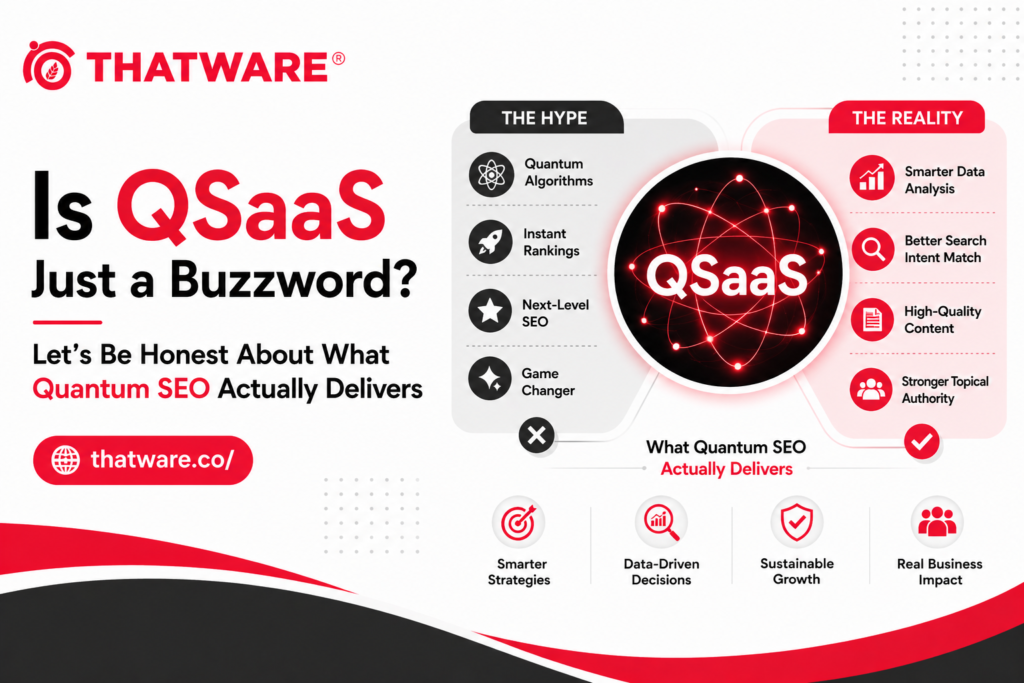
The SEO industry has a long and somewhat embarrassing history with buzzwords. Every few years a new term arrives, gets attached to a set of practices of varying quality, and eventually either gets absorbed into mainstream thinking or quietly disappears when the hype doesn’t match the results. “Quantum SEO” and QSaaS — Quantum SEO as a Service — are terms that deserve a more honest examination than they typically get in marketing materials.
So let’s actually do that. What does quantum SEO claim to do, what does it actually do when done well, what’s marketing dressing, and how do you evaluate whether it’s worth investing in? Because the honest answer isn’t “it’s all nonsense” — there’s real substance behind some of what these labels are trying to describe. The problem is separating the substance from the jargon fog.
Where the Term Comes From and What It’s Describing
“Quantum” in this SEO context isn’t a reference to quantum computing — at least, not in any operational sense that’s currently commercially deployed for SEO purposes. It’s used to describe an approach to SEO that operates simultaneously across multiple dimensions or “signals” rather than focusing on a linear sequence of optimization steps.
The underlying idea — which is genuinely worth taking seriously — is that modern search ranking is a multivariable problem where many signals interact simultaneously. Content quality, technical health, user experience signals, topical authority, entity relationships, backlink quality, behavioral metrics, AI visibility — these don’t operate in sequence, they operate in parallel. An optimization approach that addresses them in isolation, one at a time, is less effective than one that understands how they interact and builds coherence across all dimensions simultaneously.
Related brief: Cybersecurity Due Diligence in Mergers and Acquisitions
That’s actually a meaningful insight. The implementation, when done well, involves sophisticated analysis of signal interactions and coordinated optimization across multiple SEO dimensions in a way that produces compound effects rather than additive ones.
What Distinguishes QSaaS From Regular SEO Services
Qsaas services — when the concept is applied with genuine rigor rather than just renamed traditional SEO — differ from conventional approaches in a few specific ways.
The analysis layer is more complex. Rather than auditing technical SEO, then content, then links as separate exercises, a quantum-approach analysis looks at how these dimensions interact for a specific site in a specific competitive context. Which signals are most constraining? Where do improvements in one area unlock gains in another? What’s the optimal sequence and combination of interventions given the specific competitive landscape?
The strategy layer is more dynamic. Traditional SEO strategy tends to be relatively static — a set of recommendations that get executed over time. QSaaS-informed strategy is designed to evolve continuously based on performance signals, algorithm changes, and competitive movements. It’s adaptive rather than prescriptive.
The execution layer involves more sophisticated coordination. Content strategy, technical work, and authority building are planned and executed in coordination rather than in independent workstreams, because the interaction effects between them are part of the optimization model.
The Legitimate Substance vs. The Marketing Layer
Here’s where honest evaluation matters. Some agencies using “quantum SEO” or QSaaS terminology are genuinely doing sophisticated, multi-signal, coordinated SEO work that the label is trying to capture. Others are doing entirely conventional SEO with an impressive vocabulary layered on top. The vocabulary doesn’t tell you which you’re dealing with.
The questions that reveal the substance: Can they explain specifically how the different dimensions of their approach interact? Can they show you examples of where a multi-signal approach produced measurably different outcomes than a single-dimension approach would have? Do they have analytical methodology that goes beyond standard keyword and backlink analysis? Can they articulate what they’d do differently for your specific competitive situation versus a generic SEO engagement?
If the answers to these questions are specific, demonstrable, and reveal genuine analytical depth — the label might be jargon-y but the underlying capability is real. If the answers are vague and fall back on impressive terminology without concrete content — you’re likely looking at marketing wrapper around conventional services.
Where Quantum-Approach Thinking Adds Real Value
The competitive contexts where genuinely sophisticated, multi-signal SEO thinking adds the most value over conventional approaches are fairly specific.
Highly competitive categories where incremental single-dimension improvements have diminishing returns. If everyone competing in your space has good technical SEO and reasonable content quality, the edge comes from finding the combinations of factors that produce compound effects — something that requires more sophisticated analysis than standard auditing provides.
Categories where Google’s ranking behavior is complex and multi-factorial. E-YMYL (Your Money Your Life) categories — finance, healthcare, legal — have ranking dynamics that are particularly sensitive to trust and authority signals interacting with content quality. Understanding those interactions matters more than in simpler categories.
Brands at inflection points — launching into new markets, recovering from algorithm penalties, rebuilding after significant site changes — where the sequencing and interaction of multiple optimization dimensions determines how quickly and effectively the recovery or expansion happens.
Quantum seo services that clearly understand these contexts and can explain concretely why their approach is more appropriate than conventional SEO for your specific situation are worth evaluating seriously. The ones that deploy the terminology without that specificity are selling vocabulary, not capability.
How to Evaluate the Claim Practically
If you’re considering a QSaaS engagement, a practical evaluation framework: ask the agency to walk you through a specific competitive analysis of your category and explain what the “quantum” or multi-signal dimension of their approach would identify that a conventional analysis would miss.
That’s a specific, testable request. Either they can do it — showing you an analysis that’s genuinely more sophisticated than keyword research and technical auditing — or they can’t, which is your answer. Don’t let the answer be a pitch deck that describes the philosophy of their approach without demonstrating it on your specific situation.
The best version of quantum SEO thinking is real, valuable, and increasingly necessary as search becomes more complex. The label is often more trouble than it’s worth — it invites skepticism that some providers haven’t earned and gives cover to others who haven’t earned the substance. Judge what’s behind the label, not the label itself.
`