
Water is one of those things most of us take for granted until something seems wrong. Maybe your tap water has an unusual taste, you notice mineral deposits around the faucets, or your shower leaves your skin feeling dry. Sometimes the signs are subtle, and sometimes they’re hard to ignore. Either way, water quality can affect your daily routine more than you might expect.
The good news is that improving household water doesn’t necessarily mean replacing every fixture or investing in the most expensive equipment available. The right solution depends on what’s in your water, where the problem occurs, and what you want to achieve. Understanding the available filtration options is a sensible first step toward making a choice that suits your home.
Start by Understanding Your Water
Before shopping for a filtration system, find out what you’re trying to remove or reduce. Water quality varies according to its source, local treatment processes, plumbing materials, and the condition of any private well or storage system. Two homes on the same street can sometimes experience different issues.
Some households struggle with hard water, which contains elevated levels of minerals such as calcium and magnesium. These minerals can leave spots on dishes, create scale inside appliances, and make soap less effective. Other homes may have concerns about chlorine taste or odour, sediment, or particular contaminants that require targeted treatment.
Appearance alone can’t tell you whether water is safe. Clear water may still contain substances that aren’t visible, while cloudy water isn’t automatically dangerous. A suitable water test can help identify specific concerns and prevent you from buying equipment that doesn’t address the actual problem.
If you’re connected to a municipal supply, review any available local water quality reports and consider additional testing if you have concerns about your home’s plumbing. Private well owners should follow appropriate testing recommendations for their location and circumstances.
Related brief: Why Quality Water Treatment Parts Matter More Than Most People Realize
What Does Whole-Home Filtration Actually Do?
A filtration system installed where water enters the house treats water before it travels to individual taps, showers, washing machines, and other connected fixtures. This approach can be useful when you want to address a water quality concern throughout the property rather than at a single outlet.
A properly selected whole home filtration system may reduce certain unwanted substances, improve taste or odour, or capture sediment before it reaches household plumbing. However, the results depend entirely on the filter technology and the contaminants present. Not every system removes every substance, and filtration shouldn’t be confused with water softening or disinfection.
For example, sediment filters are designed to capture particles such as sand and rust. Activated carbon filters can reduce chlorine and certain compounds that affect taste and smell. Other treatment technologies target different water quality concerns. The equipment should match the test results, not simply a broad promise printed on a product label.
It’s also important to check the system’s rated flow capacity. A unit that performs well in a small household might not supply enough treated water when several showers, taps, or appliances operate simultaneously. Proper sizing helps maintain comfortable water pressure while delivering the intended treatment.
The Benefits of Treating Water Throughout the House
One of the main reasons homeowners consider whole-house systems is convenience. Instead of treating water at just one location, the system can provide the specified treatment to multiple outlets throughout the property.
The potential whole home filtration benefits include reduced sediment entering household plumbing, improved water taste or smell where the chosen technology is suitable, and less exposure to certain unwanted substances in water used for everyday activities. Depending on the system, treatment may also help protect downstream equipment from particular water quality problems.
Still, expectations need to be realistic. A standard sediment or carbon filter won’t necessarily remove dissolved minerals responsible for hard water. It also won’t automatically make water microbiologically safe. If testing identifies bacteria, nitrates, lead, or another specific contaminant, the solution must be designed to address that concern effectively.
Maintenance is another consideration. Filters become less effective when they’re used beyond their recommended service life, and neglected equipment can affect water flow or treatment performance. Ask how often cartridges need replacing, whether the system requires professional servicing, and what replacement parts are likely to cost.
A whole-house system is most useful when its capabilities align with a clearly identified household need.
When a Drinking Water System Under the Sink Makes Sense
Not every water concern requires treatment at every tap. Some people mainly want better-tasting water for drinking, making tea, preparing meals, or filling reusable bottles. In that case, a point-of-use system installed near the kitchen sink may be a more practical option.
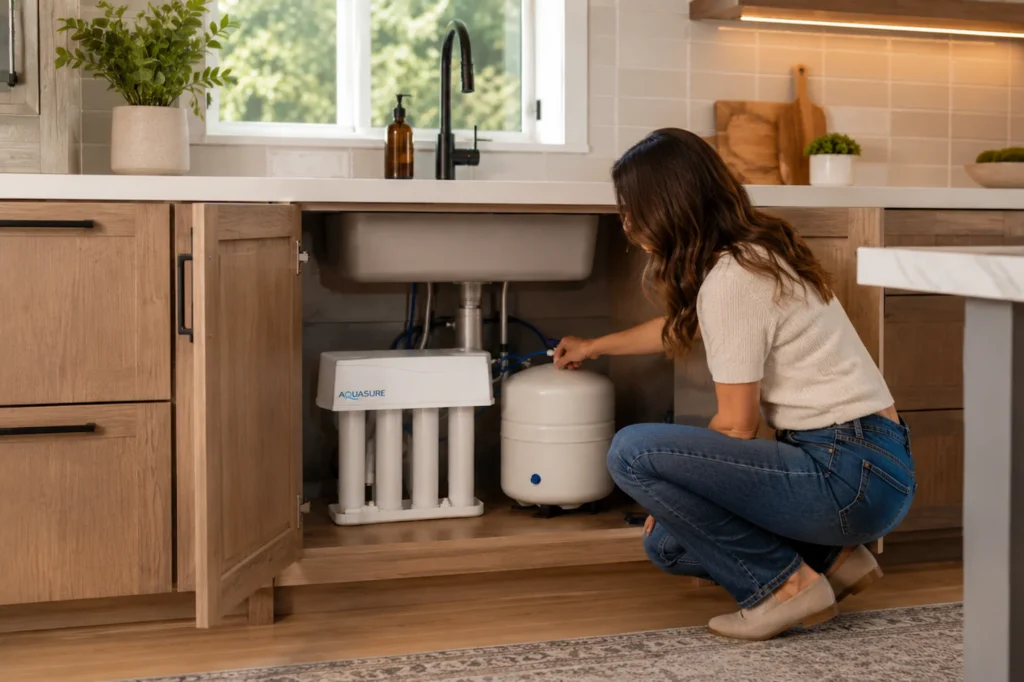
Under-the-sink drinking water systems treat water at a specific outlet, usually using one or more filtration stages. Depending on the model, these may include sediment filtration, activated carbon, or reverse osmosis. Each technology has different strengths, so it’s worth checking the manufacturer’s performance data before making a decision.
Reverse osmosis systems, for instance, can reduce many dissolved substances when properly designed and maintained. They typically produce a separate stream of concentrated wastewater, and their performance depends on the membrane, incoming water conditions, and system configuration. Carbon-based drinking water filters may be simpler and more affordable when the primary concern is taste or chlorine odour.
A dedicated drinking water system can also be easier to install when whole-house treatment isn’t necessary or practical. The trade-off is that water at other taps remains untreated by that particular unit.
Think about your habits. If drinking water quality is your main priority, a kitchen-based solution might be enough. If sediment, chlorine-related concerns, or other identified issues affect water throughout the home, a broader treatment strategy may deserve consideration.
Can You Combine Both Approaches?
In some homes, combining whole-house treatment with a drinking water system offers a sensible middle ground. A sediment filter or other suitable system at the main supply can address a specific issue affecting the property, while a separate kitchen unit provides additional treatment for drinking and cooking water.
This doesn’t mean every household needs two systems. Adding unnecessary equipment increases the initial expense, takes up space, and creates more maintenance responsibilities. The goal is to solve the problem effectively, not build the most complicated setup possible.
A qualified water treatment professional can explain whether a combined arrangement offers a meaningful advantage based on your test results. Ask for a clear explanation of what each component does, what it doesn’t do, and how you’ll know when maintenance is due.
Installation, Maintenance, and Long-Term Costs
Price is important, but the purchase cost tells only part of the story. Before choosing a system, consider installation, replacement filters, servicing, water usage, and any electricity requirements. Reverse osmosis systems, for example, may need periodic membrane replacement in addition to regular filter changes.
Installation quality matters, too. Incorrect connections, poor sizing, or unsuitable placement can create leaks, reduce performance, and make routine maintenance harder than it needs to be. Check warranty conditions and confirm whether professional installation is recommended or required.
It’s wise to ask for a written estimate that separates equipment, labour, and ongoing expenses. A reputable provider should explain the system’s limitations rather than suggest it will solve every possible water issue.
Make the Decision That Fits Your Home
Better water doesn’t always require a major investment. Sometimes a targeted drinking water filter is all you need; in other cases, testing may reveal a reason to treat water throughout the property. The right answer comes from understanding the problem first and choosing technology that addresses it.
Start with reliable information, compare suitable systems, and pay attention to maintenance requirements as well as upfront pricing. Don’t rely on vague claims or assume that one filter can remove every contaminant.
When your treatment system is chosen for your actual water conditions and cared for properly, it becomes a practical part of everyday home life. The aim isn’t simply to install equipment. It’s to have greater confidence in the water you use, a clearer understanding of your options, and a solution that continues to make sense over time.
